What is the ROI Difference Between a $3,000 and a $40,000 Website? (2026 Analysis)

What is the ROI Difference Between a $3,000 and a $40,000 Website?
Spending $40,000 on a website might make your accountant nervous, while a $3,000 site feels like a "safe" and responsible bet. But here’s the real question that determines your business's future: What is the actual Return on Investment (ROI) difference over a 24-month period?
Is a $40k site a luxury expense, or is it a high-precision revenue engine?
Is a $3k site a bargain, or is it a hidden cost trap that leaks potential revenue every single day?
In this deep dive, we’ll break down the numbers, technical performance gaps, and the real-world business impact so you can make an informed decision for your company.
1. Understanding the True Meaning of Website ROI
A website is not an "expense"—it is a business asset. Its value isn't determined by its looks or its loading speed alone, but by how much business it generates compared to what it costs to build and maintain.
The ROI Formula:
ROI (%) = [(Total Revenue from Website – Total Cost of Website) ÷ Total Cost of Website] × 100
The critical differentiator is that:
- A $3,000 website is usually built for presence (checking a box so people can find you).
- A $40,000 website is built for performance (proactively finding and converting customers).
What a $40k professional investment covers:
- Psychological Branding: Positioning your business as the "no-brainer" premium choice.
- Deep SEO Strategy: Mapping thousands of keywords to a high-authority content plan.
- Conversion-Focused UX: Using heatmaps and data to guide users toward the "Buy" button.
- Advanced Integrations: Native connections to your CRM, ERP, and automated marketing funnels.
2. The $3,000 Website: The "Starter" Option
A $3,000 site is like a starter apartment. It’s functional, it houses your brand, but it isn’t built to handle a growing family of features or a massive influx of traffic.
What You Typically Get:
- Template-Based Design: Often built on WordPress, Wix, or Squarespace with a pre-made theme.
- Surface-Level SEO: Basic metadata and a sitemap, but rarely deep technical or keyword research.
- Limited Customization: If you want a specialized feature (like a custom portal), you’ll often be told it's "impossible" or requires a paid plugin that breaks other things.
- DIY Maintenance: Security updates and bug fixes usually fall on your plate.
ROI Reality: This is perfect for freelancers, local shops, or brand-new startups. It typically breaks even within 6–12 months through modest lead generation. However, it often has high bounce rates (50–80%) because the generic design doesn't immediately build trust with high-value clients.
3. The $40,000 Website: The "Growth" Engine
A $40k site isn’t just a "prettier" version of a $3k site. It is built on a completely different architectural foundation, often using custom web development frameworks like Next.js.
What You Typically Get:
- Custom-Engineered UX: Tailored specifically to your customer's journey. No fluff, just a streamlined path to conversion.
- Technical SEO Mastery: Site structure designed for "Zero-Jank" performance and perfect Core Web Vitals, making Google love your site.
- Premium Copywriting: Every word is written by conversion experts to address customer pain points.
- Infinite Scalability: Built to handle 100,000+ monthly visitors and easy global expansion.
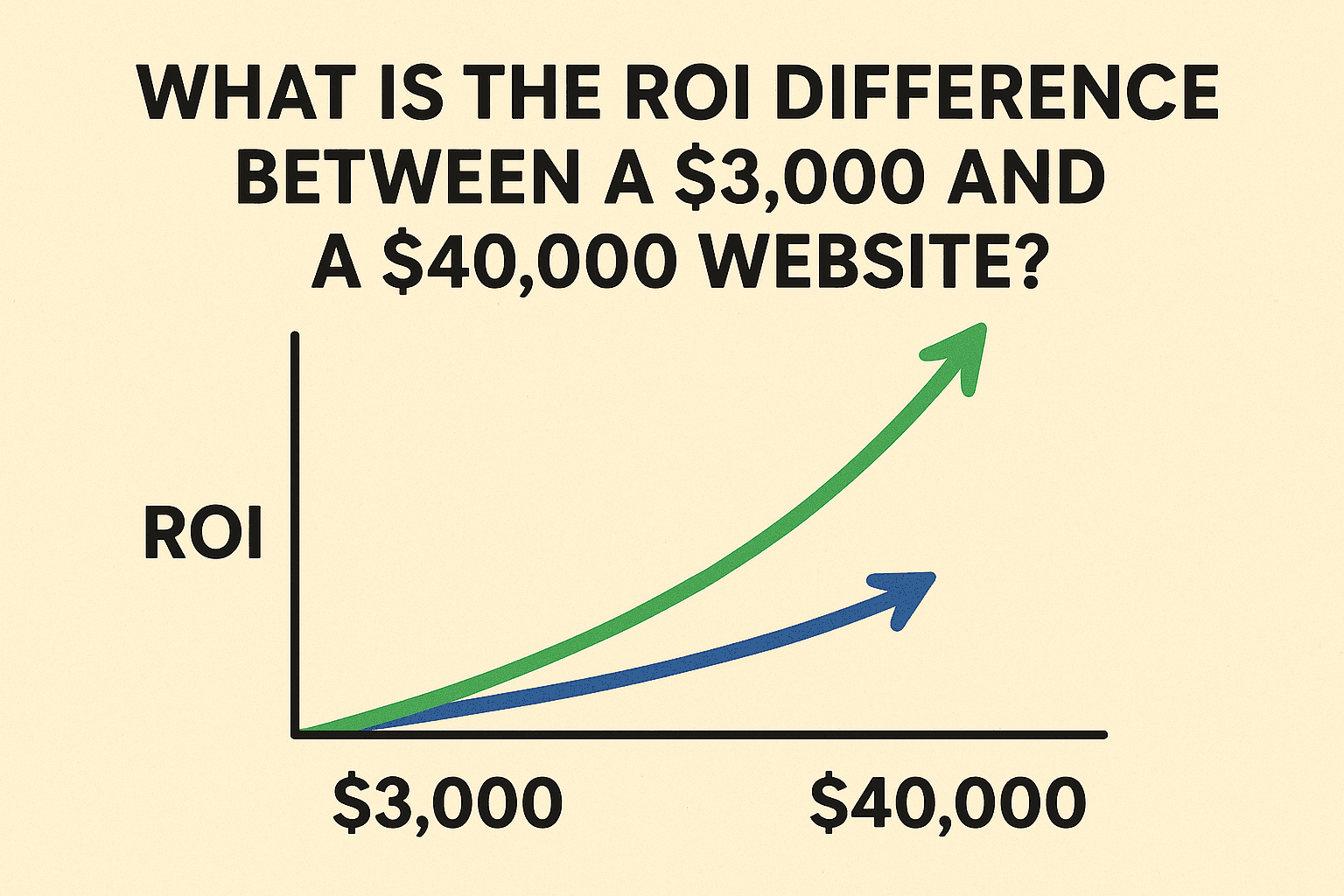
The Financial Math: Let's assume the $40k site improves your conversion rate from 1% to 3%.
- $3k Site: 5,000 visitors → 50 leads → 10 sales ($1,000 each) = $10,000 Revenue.
- $40k Site: 5,000 visitors → 150 leads → 30 sales ($1,000 each) = $30,000 Revenue.
In just one month, the "expensive" site has generated $20,000 more in revenue. Over a year, that’s a $240,000 difference.
4. Where the ROI Diverges: A Feature Comparison
| Factor | $3,000 Website | $40,000 Website |
|---|---|---|
| Development Strategy | Task-based (Build a site) | Outcome-based (Grow a business) |
| Load Speed | 3 - 6 Seconds (Heavy plugins) | < 2 Seconds (Custom Next.js/SSR) |
| Trust Factor | Average (Looks like a template) | Elite (Looks like a market leader) |
| Lead Quality | Generic traffic | High-intent, filtered leads |
| Long-term Cost | High (Lost opportunity + rework) | Low (Stable asset with high yield) |
Frequently Asked Questions (FAQ)
Is a $40,000 website always better than a $3,000 one?
Not for everyone. If you are a local florist, a $3k site is plenty. But if you are a B2B SaaS, an e-commerce brand, or a high-end service provider, the $3k site will cost you more in lost leads than the $40k site costs in cash.
How quickly can I see ROI on a $40,000 investment?
Most high-performance sites pay for themselves within 12–18 months through increased conversion rates and reduced customer acquisition costs (CAC).
What makes a website cost $40,000?
It's the thousands of man-hours spent on strategy, UI/UX design, custom engineering, expert copywriting, SEO research, and rigorous quality assurance. You aren't just paying for code; you're paying for a tested business strategy.
Can I upgrade a $3,000 site to a $40,000 site later?
Usually, no. The fundamental architecture of a template site (like WordPress) is very different from a custom Next.js site. Most businesses choose to "rip and replace" once they hit their growth limits.
Why do I need custom development for ROI?
Custom development allows us to remove all the "bloat" that slows down standard sites. It also allows us to build unique features that give you a competitive advantage that competitors can't simply buy for $50 on a theme store.
Conclusion: Don't Just Buy a Site—Buy an Asset
In 2026, the digital landscape is more competitive than ever. A $3,000 site is "cheap" upfront but can be the most expensive mistake you make if it fails to convert your hard-earned traffic.
A $40,000 site like those built by Codestam Technologies is a strategic investment. It is designed to be a compounding asset that scales your revenue, builds your brand authority, and provides a multi-year return on every dollar spent.
👉 Ready to build a high-performance revenue engine?
Take the Next Step
- Explore Our Work: Premium Software Development India
- Get a Free ROI Audit: Contact Our Strategists
- Read More: How to Choose the Right Software Partner